the courtship room
He sang, she heard, she answered. Drive his command group and the whole chain lights up: his song rises and so does her answer. Part one put her FlyWire FAFB v783 brain and his FlyEM male CNS brain from FLYBRAIN in the same room. The inputs are chosen and their actions emerge from the running brains. The controls and predictions were written down before the runs. This is the record, and the starting point for part two.
he decides
His P1 cells are read every window as a courtship command group. We chose to send her scent through Or47b neurons and nearby contact cells. Driving his command group from above raised his song and her answer.
In part three, v9 cooled him at three chosen doses: his song did not become dependent on his command cells, and removing her scent and contact drive raised his command on every seed at every dose. The step did not hold as tested; v11 traced the suppression to the Or47b scent cue, while contact removal stayed open.
he sings
His pIP10, the descending song command neuron, is read as song and rendered as a real waveform. His pulse and sine wing motor neurons determine the mix. A control jitters the rhythm with the same energy; another silences P1. Together they let us ask what the rhythm and his command group contribute to her answer.
she hears
The waveform reaches her Johnston's organ through the same frequency bands the music room uses. We chose the bands and the slices; the receiving cells come from her map. Her brain runs the full step. Song reaches her through this ear, and her response rises over silence.
she answers
Her pC1 and vpoDN cells are read; vpoDN is the “yes” descending neuron. Her oviDN cells are read as the sign of a no. We chose virgin and mated states by driving or silencing sex-peptide sensory cells. With the waveform ear, song brought her answer across the chosen acceptance threshold in most seeds; silence left it below.
The wire carrying her state was already in her own FlyWire map: her SAG cells have outputs, but a serotonin transmitter prediction silenced them in a graph builder that keeps only acetylcholine, GABA and glutamate edges. BANC, a second female's brain and nerve cord map, showed the same route to pC1 in the same order and made us look again. In part two we turned her own synapses back on with a chosen positive sign.
he adapts
We chose a starting position inside his field of view so her silhouette reaches his eye. His LC10a cells are the visual class that tracks a female.
In part three, v10 drove his LC10a from her measured position: his mean song rose and the pair came closer than with the drive off. It did not establish that his next note followed what he saw; this step did not hold as tested.
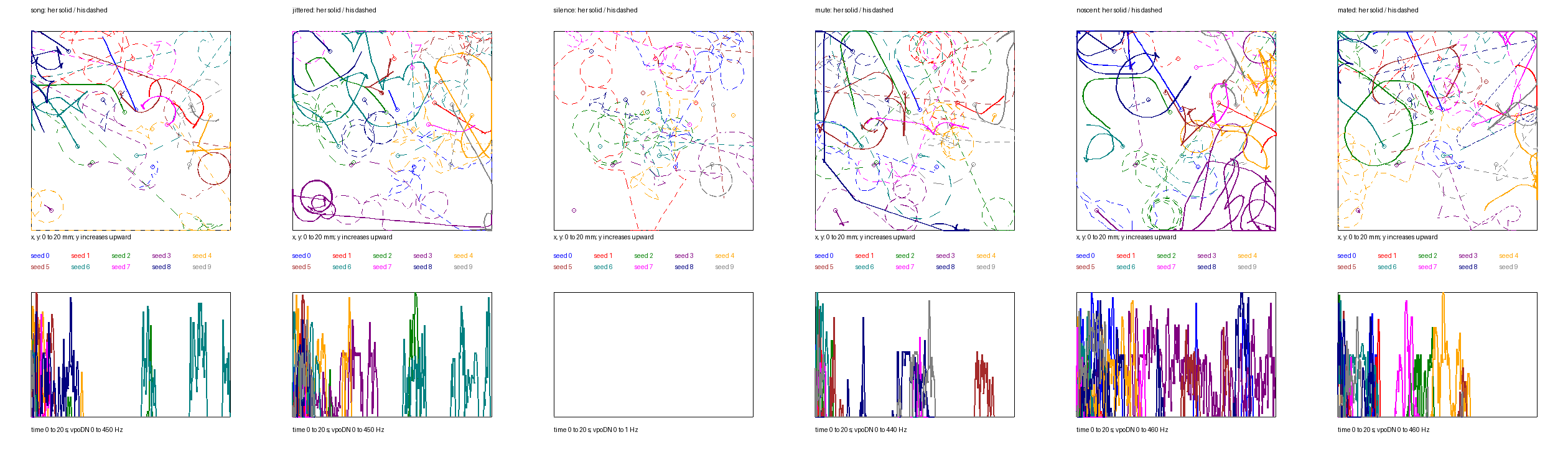
what held, and what is open
In part one, song over silence raised her vpoDN and her pC1. Driving his command group raised his song and her answer, with her vpoDN up +98.5 Hz over ordinary song. Those links held. Rhythm remains open: her ear now hears a waveform, and the brains run near ceiling so small signals get lost. Approach is open because there is no heading readout yet. Silencing P1 and testing scent and sight remain open because the loop is noisy at this excitation. A mated no remained open with the state route excluded by the builder; the hand-closed pC1 gate also left that question open. Part two tests her restored route below.
| prediction | outcome |
|---|---|
| P1 · her vpoDN, song over silence | held |
| P2 · her pC1, song over silence | held |
| P3 · her answer, rhythm over jitter | open |
| P4 · closer with song than silence | open |
| P5 · his pIP10 and song fall with P1 silenced | open |
| P6 · her answer falls with P1 silenced | open |
| P8 · his P1 rises with her scent | open |
| P9 · her answer falls when mated | open |
| P11 · his LC10a rises with sight | open |
| P13 · driving P1 raises his pIP10 and song | held |
| P14 · driving P1 raises her answer | held |
| P9' · her answer falls with the pC1 gate closed by hand | open |
| P17 · v7: she can say no | held |
| P18 · v7: she still hears | open |
| P19 · v7: the state reaches her receptivity cells | held |
| P17 · v8: she can say no | held |
| P18 · v8: she still hears | open |
| P19 · v8: the state reaches her receptivity cells | held |
| P21 · v9: command carries song, scale 0.9 | open |
| P21 · v9: command carries song, scale 0.8 | open |
| P21 · v9: command carries song, scale 0.7 | open |
| P22 · v9: scent raises his command | reversed at every scale; open |
| P25 · v10: the LC10a drive lands | held |
| P26 · v10: his next note follows the cue | open, both channels |
| P27 · v10: he turns toward her | open |
| P29 · v11: removing Or47b scent raises P1 | held |
| P30 · v11: removing contact raises P1 | open |
| P31 · v11: removing Or47b scent raises song | held, command and delivered sound |
| P31 · v11: removing contact raises song | open |
| P33 · v12: pIP10 and RMS, song over mute, scale 0.9 | open |
| P34 · v12: P1, song over noscent, scale 0.9 | open, negative mean |
| P33 · v12: pIP10 and RMS, song over mute, scale 0.8 | open |
| P34 · v12: P1, song over noscent, scale 0.8 | reversed; open |
| P36 · v13: LC10a, song over blind | open |
| P37 · v13: pIP10 and RMS, song over mute | open |
| P38 · v13: P1, song over noscent_orn | open |
| P39 · v13: next note follows LC10a over shifted control | open, both channels |
| P41 · v14: total rate, 200 over 20 Hz dose | reversed; open |
| P42 · v14: pIP10 and RMS, song over mute, 200 Hz dose | open |
| P43 · v14: P1, song over noscent_orn, 200 Hz dose | open |
| P42 · v14: pIP10 and RMS, song over mute, 50 Hz dose | open |
| P43 · v14: P1, song over noscent_orn, 50 Hz dose | open |
| P42 · v14: pIP10 and RMS, song over mute, 20 Hz dose | open |
| P43 · v14: P1, song over noscent_orn, 20 Hz dose | open |
In part one, with song, her answer met the chosen acceptance rule in 90% of seeds. Silence brought no seeds across the threshold.
Driving his command group raised his pIP10, delivered song and her vpoDN in every seed.
Closing her gate by hand left 90% of seeds meeting the acceptance rule. A no remained open in that run.
the full record (pull request to FLYBRAIN): build/courtship_report.md holds the first comparisons; build/courtship_addendum_report.md holds the command drive and the hand-closed gate.
part two: she can say no
Protocol v8 restores her own SAG synapses with a positive sign chosen from the functional evidence of Feng and colleagues. Her state enters at both SAG types: on for virgin, off for mated. Her positive weights are scaled by 0.7, chosen before data from the v7 ladder. The same four conditions and predictions run across ten seeds. He runs raw and unchanged.
The first run, v7, used a BANC graft: P17 +61.8 Hz held, P18 -0.4 Hz stayed open, and P19 +34.3 Hz held.
- P17 · v8: she can say no: her vpoDN, virgin song over mated song, rose +73.8 Hz (SE 0.97). All ten seeds were positive. Held.
- P18 · v8: she still hears: her vpoDN, virgin song over virgin silence, changed -0.3 Hz (SE 1.03). Open, not held.
- P19 · v8: the state reaches her receptivity cells: her pC1, virgin song over mated song, rose +38.7 Hz (SE 0.34). Held.
SE is the standard error across seeds. Meeting the chosen accept rule is counted separately from the mean rate.
| condition | accept |
|---|---|
| virgin song | 10/10 |
| mated song | 4/10 |
| virgin silence | 10/10 |
| mated silence | 0/10 |
Mean rates (vpoDN / pC1, Hz): virgin song 74.0 / 38.7; mated song 0.2 / 0.0; virgin silence 74.3 / 38.8; mated silence 0 / 0.
In this map her state opens the gate on its own; once she is willing, the song is not needed for her yes. No scale or tonic rate tested in the two calibration ladders printed in the v7 protocol made her yes require both the song and her state. The v8 calibration also left her answering in silence at the chosen scale, so P18 remains open.
part three: he decides, he adapts
These two steps did not hold as tested.
v9: cool him. At scales 0.9, 0.8 and 0.7, P21 stayed open: song minus P1-muted pIP10 means were +1.17 (SE 1.75), +1.28 (SE 0.65) and +0.42 Hz (SE 0.46). Delivered sound RMS differences were +0.00225 (SE 0.00304), +0.00424 (SE 0.00199) and +0.00213 (SE 0.00193), in the same order. P21 needs both measures at the same scale; none passed. P22 reversed at every scale: song minus no scent or contact gave P1 differences of -6.32 (SE 1.23), -2.32 (SE 0.24) and -1.99 Hz (SE 0.13). Removing those drives raised his command on every seed.
v11: which cue. At the chosen scale 0.9, removing Or47b scent raised P1 by +6.78 Hz (SE 1.31): P29 held. Removing contact changed P1 by +0.11 Hz (SE 0.33): P30 stayed open. P31 held for scent removal, with pIP10 +15.99 Hz (SE 6.99) and delivered RMS +0.01354 (SE 0.00647). It stayed open for contact removal: pIP10 +0.485 Hz (SE 1.264), RMS -0.00040 (SE 0.00128). These are removal minus both cues on.
v10: drive what he sees. At the chosen scale 0.9, her measured bearing and size drove LC10a directly. P25 held: LC10a rose +14.30 Hz (SE 2.42) over drive off. Mean song rose and mean distance fell in the descriptive record. P26 stayed open against shuffled drive: the difference in correlation with the previous cue was +0.0062 (SE 0.0339) for amplitude and -0.0105 (SE 0.0420) for mode. P27 stayed open: the fraction of turns toward her changed -0.0085 (SE 0.0081) against drive off. The drive landed; following the cue did not hold.
four more levers, same answer
v12: functional signs. Making vAB3 excitatory and restoring 23 silenced mAL cells as inhibitory left P33 open at scales 0.9 and 0.8 across ten seeds of song, mute and noscent. P34, P1 in song minus noscent, was negative at 0.9 (-1.45 Hz, SE 1.03) and reversed at 0.8 (-2.07 Hz, SE 0.35).
v13: a contrast eye. Uniform grey gives no visual drive; at scale 0.9, song, mute, noscent_orn and blind left P36 unsupported (LC10a, song minus blind: -0.01 Hz, SE 0.01), with P37, P38 and P39 also open. His total rate stayed near 42 Hz per neuron with her scent and 22.7 Hz without it.
v14: less scent. With the contrast eye at scale 0.9, song, mute and noscent_orn at 200, 50 and 20 Hz left P42 and P43 open at every dose; P41 reversed (song total rate, 200 minus 20: -1.23 Hz per neuron, SE 0.47). Even 20 Hz ignites him: the fraction of windows above the chosen ignition threshold in song was about 0.96–1.0 across doses, versus 0.5 without Or47b scent.
A second adult male brain-and-nerve-cord map is missing. MaleCNS v1.0 is the newest available map; MANC contains only the nerve cord.
what this means, after the levers
Across these records, the tested olfactory input at every tested dose drives this male model into a high-rate state across the network. His command cells do not control his song as tested. Cooling, a sign correction, a contrast eye and a lower dose do not change that verdict. The records point back to the model's own dynamics: thresholds, refractory period and weight scale, alongside the synthesis choices. Calibrating these is model-level work larger than a protocol. He decides and he adapts stay open until then.
Three steps hold, with a no: he sings, she hears, she answers. Two do not, as tested: he decides, he adapts. That count combines the earlier records with these tests; an open result does not mean an effect is exactly zero.
Next questions: calibrating the model; her nerve cord; more than one male; a third brain, the mosaic. The narrow sign rule, contrast eye and scent dose have been tested above. A second adult male brain-and-nerve-cord map is still missing.
how to read this
- Rates and spikes are readouts of the running brains. Positions record movement under the chosen encoding. We write down the inputs, song rendering, movement and uncalibrated gains so each choice can be checked against the record.
- We chose raw excitation for part one so the loop could be measured at that setting. The brains run near ceiling, where small signals get lost.
- The male positive-weight scale is a chosen dose, not a measured property of him. The v9 record tests each dose separately.
- The v10 LC10a geometry drive is an intervention built from her measured bearing and size with chosen gains. It does not validate the pathway from his eye to LC10a.
- The transmitter-sign rule silences outputs from modulatory classes whose predicted transmitter gets a zero sign. Restoring her SAG route leaves that wider modelling limitation open.
- The v12 functional-sign override is literature-chosen for three cell groups: his vAB3 is excitatory, his previously silenced mAL cells are inhibitory, and her restored SAG is excitatory. It does not correct every transmitter sign. The v12 override record names the choices; v13 and v14 use the base male graph.
- The v13 contrast eye is a chosen transform of brightness relative to the grey ground. Uniform grey gives no visual drive. It is not a photoreceptor model.
- The v14 olfactory doses of 200, 50 and 20 Hz are chosen Or47b input rates with chosen distance falloff. They are not measured pheromone concentrations. The ignition threshold is also chosen.
- We chose waveform slices of 5 ms so her ear receives the sound he makes.
- Her brain runs the full 50 ms of every step in real time. The effects in this regime are smaller than in the first run.
- We chose a uniform arena to keep the room simple. Her eye is blind in that room.
- We chose to start her inside his field of view so his eye has her silhouette to read.
- Virgin and mated are chosen input states. In part one, the builder excluded her SAG outputs, so her state lacked that wired route. Closing her pC1 gate by hand was a separate intervention whose readout left a no open.
- Her SAG outputs are restored from her own export with a chosen positive sign, based on the functional evidence of Feng and colleagues. Transmitter predictions disagree: serotonin here, dopamine in BANC; neither prediction fixes the effect's sign. Her positive weights are scaled by 0.7, chosen before data from the v7 calibration ladder. SPSN, the uterine sensors, are not modelled; state enters at SAG. The builder's transmitter-sign rule also silences other modulatory cells' outputs, a limitation of the whole model.
- BANC is the second individual's brain and nerve cord map, used as a cross-check of the SAG route. The full BANC graph is built but not used here.
- The p1drive condition is an intervention chosen to measure what driving his command group can set in motion. It measures the response to that drive, not his spontaneous P1 activity.
- Cell identities that are uncertain stay marked as uncertain: his putative P1 group contains 86 cells in the male map.
- The chosen contact encoding reaches cells within 2 mm so proximity can enter the loop.
- We chose a pulse interval of 35 ms to render his pulse song.
- The pulse carrier is a chosen 250 Hz waveform.
- The sine song is a chosen 150 Hz waveform.
- Her ear uses two chosen frequency bands, shared with the music room.
- Her JO-A readout covers 94 cells from her map.
- Her JO-B readout covers 299 cells from her map.
- Her pC1 readout covers 10 cells from her map.
- Her vpoDN readout covers 2 cells from her map.
- Her oviDN readout covers 6 cells from her map.
- His LC10a readout covers 275 cells from his map.
the words on this page are ours, the numbers are theirs.
what comes next
- Calibrating the model's thresholds, refractory period, weight scale and synthesis choices, after the open results in v12, v13 and v14.
- A second adult male brain-and-nerve-cord map is missing; MANC supplies only a nerve cord.
- Her nerve cord, to extend the brain-only body readouts.
- A yes that needs both her state and his song; her restored route leaves that open.
- The contrast eye was tested in v13. LC10a and adaptation stayed open.
- The narrow functional-sign rule was tested in v12. Command-dependent song stayed open.
- The olfactory dose was tested in v14. Lower input did not recover command-dependent song.
- A third brain, the mosaic.
- A room with one female and several singers, to measure her response when the room has more than his song in it.
these are open questions. the model work is larger than a protocol.